

If you have had dental work for many years, you may eventually wonder whether it is time to replace it.
Maybe you have a filling from decades ago. Perhaps a crown has never caused you trouble, or a bridge still seems to function normally.
Does dental work eventually expire?
Not exactly.
Fillings, crowns, bridges, and other restorations can change over time, but age alone does not determine whether they need treatment.
A dentist evaluates old dental work based on its current condition, the health of the natural tooth supporting it, surrounding gums, bite, function, and any changes that have occurred over time.
At Sunset Tower Family Dental, the goal is not to replace restorations simply because they have been there for many years. It is to understand how they are performing today and recommend care based on what is actually happening in your mouth.
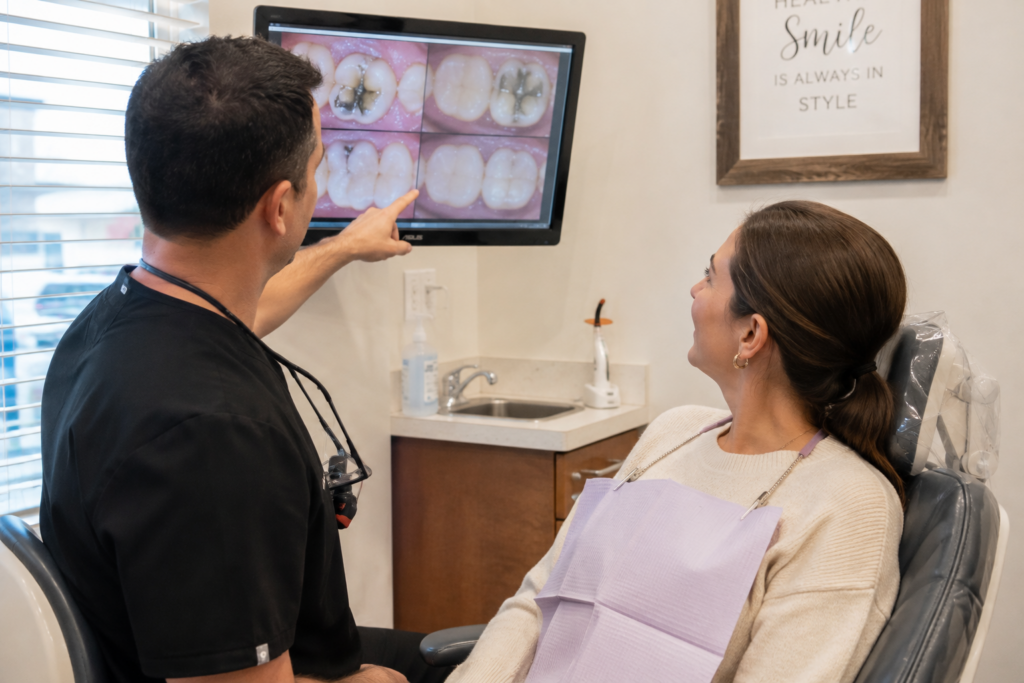
Old Dental Work Does Not Have a Universal Expiration Date
It can be tempting to think of a filling or crown as having a predetermined replacement date.
Dental restorations do not work quite that way.
Two restorations that are the same age can be in very different conditions.
Factors that may influence how dental work changes over time include:
- The type and location of the restoration
- The condition of the supporting tooth
- Oral hygiene
- Chewing forces
- Tooth grinding or clenching
- Changes elsewhere in the mouth
- Wear or damage to the restoration
That is why restorations are generally evaluated individually rather than replaced according to an arbitrary timeline.
If a restoration remains stable and functional, continued monitoring may be appropriate. When something has changed, your dentist can explain what was found and whether monitoring, repair, replacement, or another approach should be considered.
What Does a Dentist Look for When Checking Old Dental Work?
During regular dental exams and cleanings, your dentist can evaluate both your natural teeth and existing restorations.
Depending on the type of dental work, the examination may consider:
- Cracks or chips
- Wear
- Changes along restoration margins
- Signs of decay
- The condition of the supporting tooth
- Gum health
- Restoration stability
- Bite and chewing function
- Symptoms or changes you have noticed
The dentist is not evaluating only the visible restoration.
A filling, crown, or bridge depends on the health of the natural teeth and surrounding tissues associated with it. Those areas are an important part of deciding whether existing dental work is still functioning appropriately.
How Are Old Fillings Evaluated?
Many adults accumulate one or more dental fillings over time.
When checking an older filling, the dentist may evaluate how well the material remains adapted to the tooth, whether the filling shows wear or damage, and whether the surrounding natural tooth structure remains healthy.
New decay can also sometimes develop around the edges of an existing filling.
That does not mean the filling itself causes decay or that every old filling eventually develops a cavity. It simply means the natural tooth around a restoration still needs ongoing care and evaluation.
If the filling and surrounding tooth remain clinically acceptable, monitoring may be appropriate.
If a localized problem develops, the dentist may consider whether part of the restoration can be addressed conservatively or whether more extensive treatment is necessary. The recommendation depends on what is found and how much healthy tooth structure remains.
How Do Dentists Check Older Crowns?
A crown covers a larger portion of a tooth than a filling, but the natural tooth underneath and around it still matters.
When evaluating dental crowns, a dentist may consider:
- The condition of the crown
- Crown margins
- Surrounding gums
- Stability
- Comfort when biting
- The health of the supporting tooth
One common misconception is that once a tooth has a crown, it cannot develop another dental problem.
Natural tooth structure remains underneath and around the restoration. Changes such as decay can sometimes develop where natural tooth structure remains exposed.
However, a crown that has been present for many years is not automatically considered worn out.
If it remains functional and the tooth supporting it is healthy, continued observation may be appropriate.
What About an Older Dental Bridge?
An older dental bridge should also be evaluated as more than just the visible restoration.
A traditional bridge depends on neighboring teeth for support.
The dentist may evaluate:
- Bridge stability
- Supporting teeth
- Restoration margins
- Surrounding gums
- Cleanability
- Bite and function
Cleaning around and underneath a bridge is especially important because certain areas may be more difficult to reach through regular brushing alone.
If a concern develops, the next step depends on what is affected.
The issue may involve the bridge itself, a supporting tooth, surrounding tissues, or another aspect of the patient’s oral health.
Again, age by itself does not determine whether the bridge should be replaced.
Can Old Dental Work Have a Problem Without Hurting?
Yes.
Pain and sensitivity provide useful information, but they are not the only signs dentists consider when evaluating existing restorations.
Some changes may be discovered during a dental examination before they cause noticeable discomfort.
At the same time, discomfort around a restored tooth does not automatically mean the restoration itself has failed.
Tell your dental team if you notice:
- New sensitivity
- Discomfort when chewing
- A rough or sharp area
- A restoration that feels loose
- Repeated food trapping
- A change in how your teeth meet
Mentioning when the change started and when you notice it can also provide useful context.
An examination is still necessary to determine what is actually causing the symptom.
Why Do Bite and Function Matter?
Dental restorations function as part of your overall bite.
Over time, teeth can wear, neighboring teeth can change, additional dental work may be completed, or teeth may be lost.
Grinding and clenching can also place additional forces on certain areas.
For those reasons, the dentist may consider how an older filling, crown, or bridge functions within your current bite rather than judging it only by appearance.
A change in how your teeth meet does not automatically mean an older restoration is responsible.
It is simply another piece of information that can help your dentist understand the complete picture.
When Does Old Dental Work Actually Need Treatment?
Not every old restoration needs treatment.
If a restoration remains stable and clinically acceptable, your dentist may recommend continuing to monitor it during regular examinations.
When a concern develops, the appropriate response depends on the type and extent of the problem.
Depending on the findings, possible approaches may include:
- Continued monitoring
- Addressing a localized defect when appropriate
- Replacing a restoration
- Treating decay or structural damage
- Evaluating another underlying dental condition
Replacing an entire functioning restoration unnecessarily may require removing additional healthy tooth structure.
At the same time, delaying treatment of a clinically significant problem may allow the condition to become more complicated.
The decision should therefore be based on the current findings.
If treatment is recommended, you should understand what your dentist found, why it matters, what options may be available, and how the condition may change if treatment is delayed.
What If I Have Several Older Restorations?
Some patients have multiple fillings, crowns, bridges, missing teeth, or other restorative work accumulated over many years.
When several areas need evaluation, looking at the whole mouth can be more useful than treating every tooth as an unrelated concern.
Your dentist may consider:
- Which areas need attention sooner
- Which restorations remain stable
- How different restorations affect function
- Whether some areas can continue to be monitored
- How potential treatments relate to one another
For patients with more complex restorative needs, broader treatment planning may sometimes be appropriate.
However, having several older restorations does not automatically mean extensive dental rehabilitation is necessary.
The purpose of a comprehensive evaluation is to understand the entire picture before determining what treatment, if any, makes sense.
Regular Dental Visits Help Track Changes Over Time
One of the benefits of ongoing dental care is the ability to monitor changes.
A restoration that appears stable today may simply be checked again during a future examination.
If something changes, comparing current findings with previous evaluations can help the dentist determine whether additional monitoring or treatment is appropriate.
Long-term relationships also give your dental team context about your dental history, previous treatment, and oral health goals.
Sunset Tower Family Dental has served the Sunset Hills community for more than 40 years while continuing to emphasize personalized, relationship-based dentistry.
That long-term perspective fits naturally with caring for restorations and dental work patients may accumulate throughout different stages of life.
Make Decisions Based on Your Dental Health Today
Having older fillings, crowns, or bridges does not automatically mean you need extensive dental work.
What matters most is their current condition.
A thoughtful evaluation considers:
- The restoration itself
- Natural tooth structure
- Supporting gums and tissues
- Bite and function
- Symptoms
- Your overall oral health
Some restorations may continue functioning with routine monitoring. Others may eventually benefit from conservative repair, replacement, or another form of treatment depending on what the dentist finds.
At Sunset Tower Family Dental, the approach centers on patient education and individualized treatment planning.
The goal is to explain what is happening, discuss your options, and help you make decisions based on your oral health today rather than simply on how old your dental work is.
If you have older dental work and are wondering whether it still looks healthy and functions appropriately, contact Sunset Tower Family Dental to schedule an evaluation. The dental team can review your existing restorations and help you understand what, if anything, needs attention.